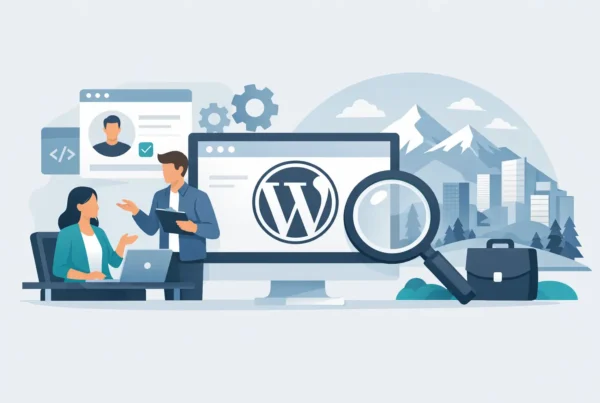

A weak website costs more than most owners realize. In Fort Collins, where referrals, local search, and first impressions all carry weight, your site often decides whether a prospect calls you, compares you, or forgets you. A strong small business website Fort Collins companies can rely on is not just a digital brochure – it is a sales tool, a credibility signal, and a growth asset.
Too many small businesses treat web design as a one-time creative project. The result looks fine for a month, then quietly underperforms for years. If your site is slow, unclear, hard to navigate, or disconnected from your brand, it will drag down lead quality and conversion no matter how good your service is.
What a small business website in Fort Collins actually needs to do
For most local businesses, the job is straightforward but not simple. Your website needs to help the right people find you, understand what makes you different, and feel confident enough to take the next step.
That means design matters, but design alone is not enough. Messaging, search visibility, user flow, speed, mobile performance, and conversion paths all shape outcomes. A polished homepage with vague copy will lose to a clearer site every time.
Fort Collins businesses also face a particular challenge. Many operate in crowded categories where competitors sound interchangeable. Contractors, professional services firms, health and wellness brands, local retailers, and B2B service providers often say the same things in slightly different ways. Your website has to create separation quickly.
Why local credibility matters more than visual polish
A beautiful site can still underperform if it does not feel trustworthy. Local buyers are not grading you like a design jury. They are scanning for proof that you understand their problem, serve their area, and can deliver without wasting their time.
That is why the most effective websites pair strong visuals with strategic content. Clear service pages, direct headlines, specific calls to action, fast load times, and evidence of real work all matter. Reviews, case studies, industry experience, and a distinct point of view usually do more for conversion than flashy motion effects.
There is a trade-off here. Highly custom experiences can elevate a brand, but they can also overcomplicate the user journey if every interaction tries too hard to impress. The best-performing sites balance personality with clarity. They look sharp, but they still make it easy to act.
The biggest mistakes on a small business website Fort Collins brands should avoid
The most common issue is vague positioning. If a visitor lands on your site and cannot tell who you help, what you do, and why you are a stronger choice within a few seconds, you have already created friction.
The second issue is weak structure. Many small business sites bury their core services, overload the navigation, or send visitors through too many clicks before they can contact the business. Good websites reduce decisions, not multiply them.
The third issue is treating SEO and conversion as separate jobs. They are connected. Search can bring traffic, but if the page does not answer intent and move the visitor forward, rankings will not produce meaningful results. On the other side, a high-converting page no one can find will stay invisible.
Another common problem is inconsistency between brand and website. If your business presents itself as premium, strategic, or high-touch, your website should reinforce that through copy, user experience, and technical quality. A mismatch creates doubt, even if visitors cannot explain why.
Strategy before screens
Before colors, layouts, or development choices, the real work starts with strategy. That means understanding your audience, your competitive landscape, and the specific actions your website needs to generate.
For one company, the priority might be booked consultations. For another, it may be qualified quote requests, phone calls, retail visits, or demo bookings. The website should be built around that goal from day one.
This is where many businesses lose momentum. They jump into design before defining message hierarchy, user intent, or key conversion pathways. It feels productive, but it usually creates rework later. Better strategy up front leads to faster decisions, cleaner design, and better performance after launch.
A more effective process starts with questions. What does the buyer need to know first? What objections show up early? What makes your offer more valuable than alternatives? What pages need to rank? What proof will move a prospect from curious to ready?
Content that converts, not just fills space
A lot of small business websites are overloaded with words that say very little. Generic copy like “quality service” or “customer satisfaction” does not create traction because every competitor says the same thing.
Strong website content is specific. It names the audience, clarifies the service, frames the problem, and points toward an outcome. It also respects how people actually read online. They scan first, then commit.
That means your headlines need to carry meaning. Your service pages should explain not only what you offer, but who it is for and what changes after working with you. Good content is not about sounding impressive. It is about reducing uncertainty.
There is also a local advantage in being precise. If you serve Fort Collins and nearby markets, your content can reflect the realities of that audience without sounding forced. Local relevance works best when it is earned through context, not repetition.
Design and development should support growth
A site can look modern and still be structurally weak. That is why serious website work has to bridge creative direction and technical execution.
Design should guide attention. Development should protect performance. Together, they create an experience that feels credible, fast, and easy to use across devices. Mobile matters especially here, because many local searches happen on the go and convert quickly when the path is frictionless.
Speed is not a side issue either. Slow pages weaken trust and hurt conversion. The same is true for clunky forms, unclear buttons, and page layouts that bury key information below layers of animation or filler.
The strongest agency partners do not treat launch as the finish line. They build with optimization in mind, so the site can improve over time based on user behavior, search performance, and conversion data.
When DIY thinking starts to cap growth
Some businesses outgrow their website before they realize it. What worked when the company was smaller stops working once the stakes are higher, the market gets more competitive, or the business needs better leads rather than more traffic.
That is usually the point where the website needs to become part of a broader growth system. Brand positioning, UX, SEO strategy, content architecture, analytics, and conversion improvement all start to matter more. If those pieces are disconnected, performance stalls.
This is also where working with a strategic partner can change the trajectory. Agencies like TripSix Design approach websites as business infrastructure, not just visual output. That difference matters when your site needs to do more than exist – it needs to create momentum.
How to evaluate your current website honestly
A simple test works well. Open your homepage and ask four questions. Is it immediately clear what you do? Is it obvious who you help? Is there a real reason to choose you over competitors? Is the next step easy and compelling?
If the answer to any of those is no, the site likely has a performance problem, even if it looks decent. Then go deeper. Check whether your service pages are distinct, whether your mobile experience feels effortless, and whether your copy sounds like your actual business or a watered-down version of it.
You should also look at outcomes, not assumptions. Are people contacting you through the website? Are the leads qualified? Are key pages getting traffic? Are visitors dropping off early? Better websites are built through evidence as much as instinct.
A better standard for small business websites
The bar is higher now, and that is good news for businesses willing to take their digital presence seriously. A high-performing website can sharpen your positioning, improve lead quality, shorten sales cycles, and make every other marketing effort work harder.
For Fort Collins businesses, that means your website should do more than look current. It should communicate value fast, build trust, rank for the right searches, and turn attention into action. Not every business needs the same features, but every growth-focused business needs clarity, credibility, and a site built with intent.
If your website feels like a placeholder, that is your signal. The right rebuild is not cosmetic. It is strategic, and it can become one of the most valuable assets your business owns.
The smartest next move is not asking whether your site looks good enough. It is asking whether it is helping your business win more of the right work.