



Most brands do not have a design problem. They have a clarity problem. If your website looks polished but prospects still hesitate, if your sales team explains your value five different ways, or if your marketing sounds busy but not memorable, you likely need a brand messaging framework guide – not more noise.
Messaging is what gives your brand commercial traction. It shapes how people understand what you do, why you matter, and why they should choose you over alternatives that may look similar on the surface. For growth-focused companies, that is not a copywriting exercise. It is strategic infrastructure.
What a brand messaging framework actually does
A brand messaging framework is a structured system that defines how your business talks about itself across channels, teams, and touchpoints. It creates alignment between positioning, audience needs, offer strategy, and conversion goals.
Without that system, marketing tends to drift. Your homepage says one thing, your sales deck says another, your ads chase clicks without building trust, and your team fills in the gaps with improvisation. That inconsistency weakens recall and slows down decision-making for buyers.
A strong framework does the opposite. It gives your business a clear point of view, a sharper market position, and language that can scale from a website headline to a pitch meeting. It also makes creative execution stronger because design, UX, and campaigns have a strategic message to carry instead of just a visual style.
Why most messaging frameworks fail in practice
A lot of messaging work sounds smart in workshops and falls apart in the real market. Usually, that happens for one of three reasons.
First, the messaging is too internal. It reflects what the company wants to say, not what the buyer needs to hear to move forward. Second, it becomes abstract. Words like innovative, tailored, and customer-centric show up everywhere because they feel safe, but they do not create distinction. Third, the framework never gets operationalized. It lives in a deck, not in the site architecture, landing pages, sales process, or campaign strategy.
That is where the trade-off shows up. Messaging should be aspirational enough to define the brand, but specific enough to drive action. If it is too broad, it blends in. If it is too narrow, it can box in future growth. The right balance depends on your stage, category maturity, and how clearly your market understands what you do.
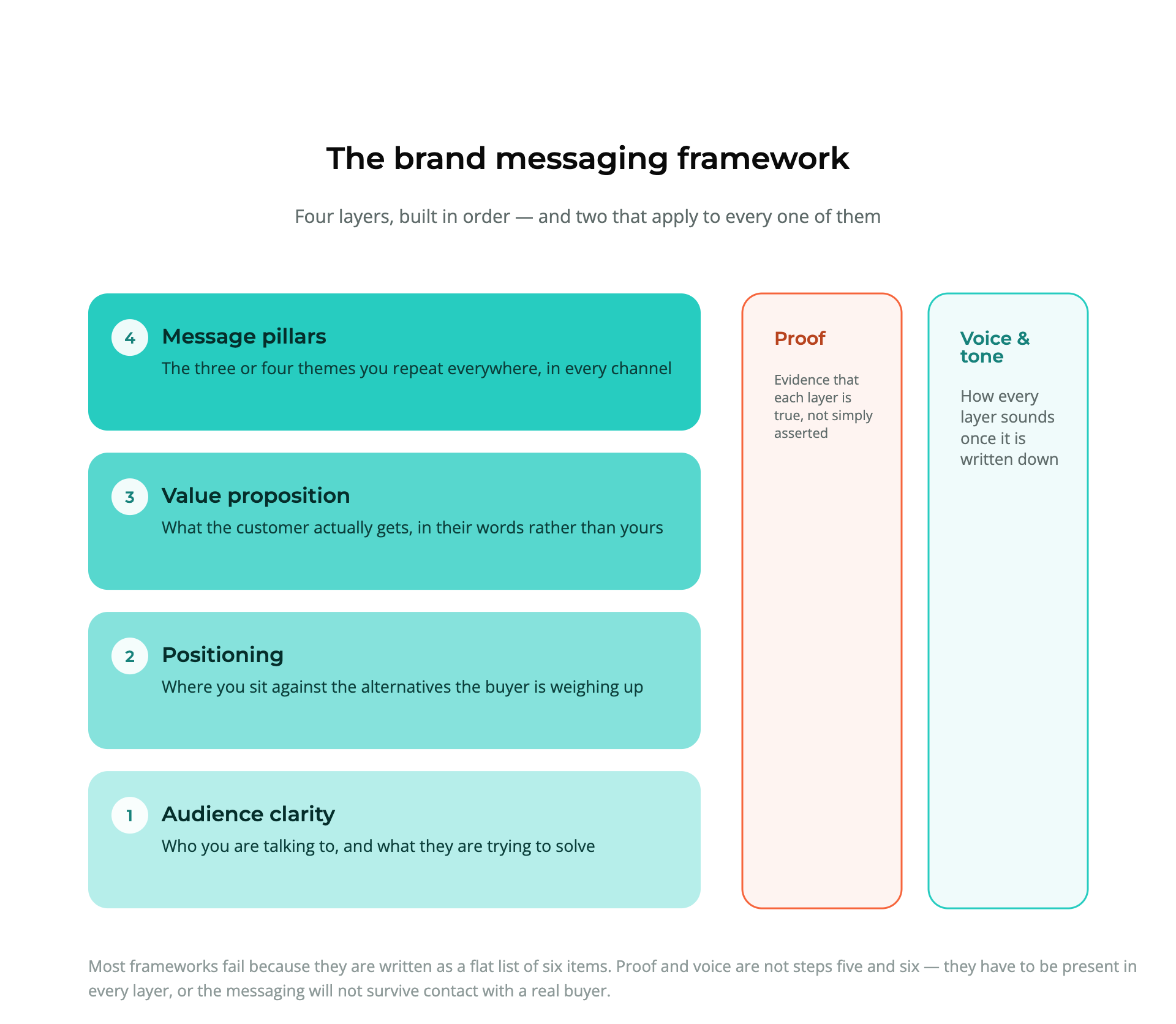
The core pieces of a brand messaging framework guide
The best way to build this is from the outside in. Start with market reality, not internal preference.
Audience clarity
You need more than a generic target market. Strong messaging begins with a working understanding of buyer pain points, motivations, objections, and desired outcomes. A founder searching for traction has different language needs than a marketing leader trying to improve conversion rates inside a mature company.
If your audience definition is vague, your messaging will be too. The goal is not to speak to everyone who could buy. It is to sound immediately relevant to the right people.
Positioning
Positioning answers the question behind every buying decision: why this brand instead of another option? That answer has to go beyond services offered. Plenty of agencies build websites, develop brands, or run digital campaigns. The difference is in how those capabilities combine, what business problem they solve, and what kind of outcome they are built to produce.
Good positioning is competitive by nature. It should account for what your market claims and where you can credibly create separation.
Value proposition
Your value proposition turns strategy into a clear promise. It should explain what you do, who it is for, and the result clients can expect. This is not the place for slogans that sound clever but vague. Buyers need clarity fast.
For many businesses, this is where momentum starts. Once the value proposition is sharp, your homepage, pitch decks, proposals, and campaign messaging stop feeling fragmented.
Message pillars
Message pillars are the 3 to 5 core ideas that support your value proposition. They give your brand repeatable themes to build around. These might include strategic depth, technical execution, measurable performance, speed to market, or category expertise – but only if you can prove them.
This matters because repetition builds recall. If every touchpoint introduces a new angle, the market never learns what to associate with your brand.
Proof
Claims without proof create friction. Proof can come from results, process, case studies, client outcomes, product capabilities, differentiators, or even the way your engagement model works. If you say you help businesses grow, show how. If you say your process improves conversion, explain where that improvement comes from.
Trust is built when message and evidence stay connected.
Voice and tone
Voice is how your brand consistently sounds. Tone is how that voice flexes by context. A bold brand does not need to sound aggressive everywhere. It does need to sound like itself across a homepage, proposal, sales email, and campaign landing page.
When voice is undefined, content gets written by channel instead of by brand. That creates inconsistency that buyers can feel even if they cannot name it.
How to build a brand messaging framework that can actually be used
This brand messaging framework guide works best when you treat messaging as a business tool, not a writing exercise.
Start by auditing what already exists. Review your website, sales materials, proposals, ad copy, onboarding documents, and stakeholder language. Look for patterns. Where are you repeating weak claims? Where do different teams describe the business in conflicting ways? Where does the language become generic?
Next, pressure-test your message against the market. Study competitor positioning, category language, and how buyers describe their problems. This step matters because strong messaging is relative. You are not writing in a vacuum. You are entering an existing conversation and trying to shift perception in your favor.
Then build the framework in layers. Start with positioning, move into your value proposition, define your message pillars, and establish proof points for each one. After that, develop practical applications: homepage headline options, elevator pitch language, service page messaging, sales narrative, and campaign hooks.
This is also where many businesses miss an opportunity. Messaging should influence structure. If your value is built on strategy plus execution plus measurable performance, your website architecture, lead journey, and calls to action should reflect that. Otherwise the message sounds right, but the experience does not reinforce it.
Where messaging shows up in revenue
The obvious place is your website, but the impact is broader than that. Clear messaging improves lead quality because it attracts people who understand your value faster. It helps shorten sales cycles because buyers spend less time trying to decode what makes you different. It also improves conversion because the path from attention to trust becomes more direct.
There is another benefit that matters for scaling companies: internal alignment. Teams move faster when they share the same language around audience, value, and differentiation. That reduces brand drift and makes execution sharper across design, development, and marketing.
For companies investing in rebranding, web redesign, or demand generation, messaging often creates the highest leverage. Better creative without better messaging can still miss. Better messaging tends to make every downstream asset perform harder.
Signs your current messaging needs work
You do not always need a full rewrite. Sometimes you need sharper positioning. Sometimes your offer is strong but buried under safe language. Sometimes the issue is not the message itself, but the lack of consistency across channels.
A few warning signs tend to show up together. Your website gets traffic but weak inquiry quality. Prospects ask basic questions that your messaging should have answered. Your team explains the business differently depending on who is talking. Competitors with less capability sound more compelling because their narrative is cleaner.
If that sounds familiar, the problem is not cosmetic. It is strategic.
A practical standard for better messaging
Good messaging should pass a simple test. It should be clear in five seconds, credible in thirty seconds, and compelling enough to move the right buyer toward action. If it only sounds impressive after a long explanation, it is not doing enough work.
That does not mean every brand needs the same level of complexity. A startup validating product-market fit may need lean, adaptable messaging. A more established business with multiple service lines may need a more structured framework to keep growth from creating confusion. It depends on your stage and your sales environment.
What stays constant is the goal: say the right thing, to the right audience, in a way that creates movement.
For businesses trying to strengthen positioning, improve lead conversion, and bring brand strategy closer to commercial performance, messaging is one of the smartest places to focus. That is true whether you are refining an existing brand or rebuilding the entire experience with a partner like Tripsix Design. The point is not to sound better. The point is to be understood faster, remembered longer, and chosen more often.
A strong message does not just describe your business. It gives your market a reason to care.
Frequently asked questions (FAQs)
What is a brand messaging framework and why do I need one?
A brand messaging framework is a structured system that defines how your business communicates across all channels and touchpoints, creating alignment between your positioning, audience needs, and conversion goals. Without it, your messaging becomes inconsistent—your homepage says one thing, your sales team says another—which weakens buyer trust and slows decision-making. A strong framework gives your business a clear point of view and language that scales from website headlines to pitch meetings.
Why do most brand messaging frameworks fail?
Messaging frameworks typically fail for three reasons: they focus on what the company wants to say rather than what buyers need to hear; they rely on abstract, generic language like “innovative” or “customer-centric” that creates no distinction; or they never move beyond a PowerPoint deck into actual website architecture, sales processes, and campaigns. The most successful frameworks balance being aspirational enough to define your brand while remaining specific enough to drive action.
What are the core components of an effective brand messaging framework?
The core components are: audience clarity (understanding buyer pain points and motivations), positioning (why your brand matters versus competitors), value proposition (what you do, who it’s for, and the result), message pillars (3-5 repeatable core ideas), proof (evidence that supports your claims), and voice and tone (how your brand consistently sounds). These elements work together to create a cohesive system that guides all communication.
How does brand messaging impact revenue and sales?
Clear messaging improves lead quality by attracting people who understand your value faster, shortens sales cycles by reducing buyer confusion, and increases conversion rates by creating a more direct path from attention to trust. Additionally, it creates internal alignment so teams move faster and execute more sharply, and it makes every downstream asset—from websites to ads to proposals—perform harder.
What's the difference between positioning and a value proposition?
Positioning answers why someone should choose your brand over competitors by identifying your competitive advantage and unique market separation. A value proposition translates that positioning into a clear, specific promise by explaining what you do, who it’s for, and the concrete result clients can expect. Positioning is strategic; the value proposition is the practical statement buyers see first.
How do I know if my brand messaging needs to be updated?
You may need messaging work if your website looks polished but prospects hesitate to buy, your team describes your value in five different ways, your marketing sounds busy but unmemorable, or you notice inconsistency across channels. You don’t always need a complete rewrite—sometimes you need sharper positioning, clearer language, or better consistency across your website, sales materials, and ads.