



If your firm manages wealth, risk, lending, or compliance, your brand is already making promises before a single conversation happens. That is the real job of financial services branding – not making a firm look polished for the sake of it, but making expertise feel credible, clear, and worth trusting.
This category has a branding problem. Too many firms look interchangeable. Same navy palette. Same skyline photography. Same language about partnership, integrity, and tailored solutions. None of that is wrong, exactly. It is just forgettable. And in financial services, forgettable is expensive.
People do not hire a financial advisor, lender, insurer, or fintech platform because the logo is pretty. They hire the firm that feels stable, competent, and easier to believe. Good branding helps create that feeling. Great branding turns it into momentum across every touchpoint, from your website to your pitch deck to the first sales call.
Why financial services branding carries more weight
In many industries, weak branding can be patched over with a strong product demo or a clever campaign. Financial services does not get that luxury. The stakes are higher. You are asking people to trust you with money, compliance, planning, debt, investment decisions, or operational risk. That means your brand has to work harder, faster, and with less room for ambiguity.
A vague message does more damage here than in most sectors. If a prospect lands on your homepage and cannot immediately tell who you help, what you do, and why your approach is different, they will not stick around to decode it. They will move on to the firm that feels more certain.
That is why branding in this space is not a surface-level exercise. It influences perceived risk. It affects lead quality. It shapes whether your business looks established enough for enterprise buyers or approachable enough for direct consumers. It can even affect recruiting, because top talent notices the same signals clients do.
What strong financial services branding actually looks like
The best brands in this sector do three things at once. They communicate trust, create distinction, and reduce friction.
Trust is the baseline. Without it, nothing else matters. But trust on its own is not a strategy. Plenty of firms look trustworthy and still blend into the background. Distinction is what helps buyers remember you, compare you, and choose you. Reducing friction is what makes the next step obvious, whether that is booking a consultation, requesting a proposal, or starting an application.
A strong brand system usually starts with positioning. Who exactly do you serve? What problem do you solve better than competitors? Why does your model, process, or perspective matter? If your answer sounds broad enough to fit fifty other firms, you do not have positioning yet. You have category wallpaper.
From there, messaging has to become specific. Not clever for the sake of clever. Clear. That often means replacing generic claims with language that reflects the real buying criteria of your audience. A CFO evaluating treasury support is not looking for inspiration. They are looking for confidence, control, and competence. A founder looking for capital advisory may care about speed, access, and strategic guidance. Different audience, different message.
Visual identity matters too, but not in the way many firms assume. Looking premium is useful. Looking current is useful. Looking expensive for no strategic reason is not. The visual system should support the positioning, not distract from it. Sometimes that means a conservative aesthetic with sharper typography and cleaner structure. Sometimes it means breaking category norms in a controlled way. The key phrase is controlled. Financial brands can stand out, but they cannot look reckless.
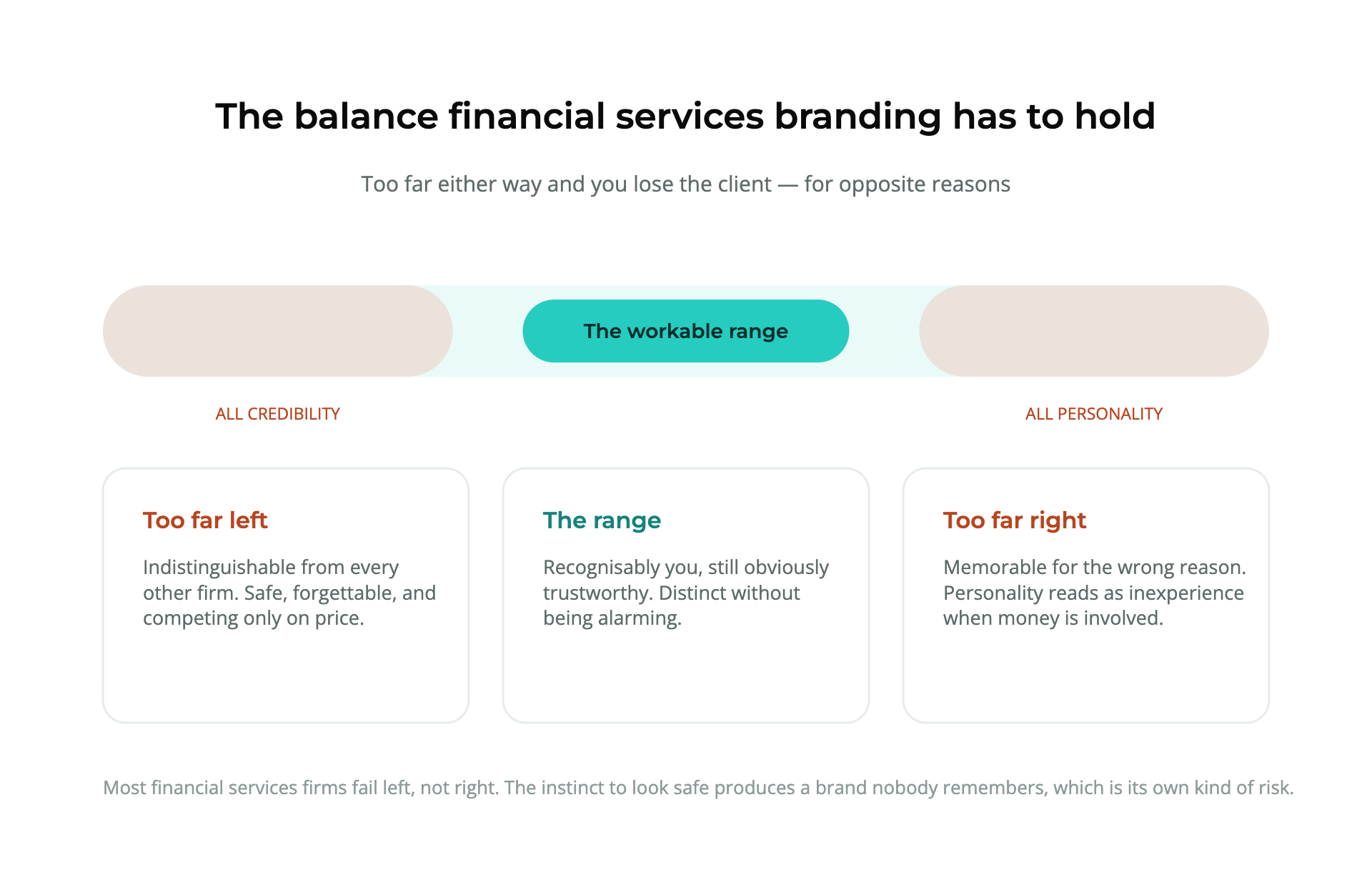
The balance between credibility and personality
This is where a lot of firms get stuck. They worry that showing too much personality will make them seem less serious. So they strip everything back until the brand sounds like a legal disclaimer wearing a blazer.
The trade-off is real, but it is manageable. Financial brands do need restraint. They do not need to sound lifeless.
Personality in this sector should come through in the way you explain complexity, the clarity of your point of view, and the consistency of your experience. A firm can be intelligent, approachable, and highly credible at the same time. In fact, that combination is often more persuasive than formality alone.
The right tone depends on your market. Private wealth branding may lean more personal and relationship-driven. Institutional finance may need more precision and authority. Fintech may have room for more energy and optimism, but still needs to prove security and operational maturity. It depends on who is buying, what is at stake, and how much education the sale requires.
Where most firms get financial services branding wrong
The biggest mistake is treating branding as a visual refresh instead of a business tool. A new logo cannot fix confused positioning. A nicer website cannot solve unclear messaging. Better photography cannot compensate for a value proposition that sounds like everyone else in the industry.
Another common problem is internal bias. Leadership teams often describe the business from the inside out. They talk about service lines, credentials, and capabilities in a way that makes sense internally but not to buyers. Clients are not asking how your departments are organized. They want to know whether you understand their problem and whether your approach feels lower risk than the alternative.
Then there is the compliance issue. Some firms use regulation as a reason to avoid saying anything memorable at all. Yes, legal review matters. Yes, claims need to be careful. But compliance should shape the message, not flatten it into corporate oatmeal.
And finally, many firms stop at strategy. They do the workshop, approve the messaging, maybe update a few brand files, and then nothing changes operationally. Most strategy decks die in a Google Drive folder. Branding only starts working when it shows up in the website structure, sales materials, onboarding experience, content themes, and client communications.
How to build a brand that converts, not just impresses
Start with the audience, not the aesthetic. You need to understand what different buyers are worried about, how they evaluate options, and what language they trust. That means looking at sales conversations, client objections, proposal feedback, and competitor positioning – not just moodboards.
Next, sharpen your category position. You do not need to be everything to everyone. In fact, that is usually the fastest way to weaken perception. A more focused brand often creates stronger demand because it gives the right clients an immediate reason to care.
Then align the brand with the digital experience. This is where many firms leave money on the table. If your homepage reads like a mission statement and your calls to action are vague, strong branding never gets the chance to convert. The site should guide visitors through a simple chain of understanding: who you help, what you solve, why you are credible, and what to do next.
Content also plays a bigger role than many financial firms realize. Not endless publishing for the sake of activity. Useful content that demonstrates judgment. When your brand is built around clarity and expertise, your articles, insights, and case examples become proof. They show how you think before a prospect ever gets on a call.
This is also where integrated execution matters. Brand strategy, UX, messaging, SEO, and development cannot operate like separate islands if you want consistent performance. A polished brand with a confusing website is still confusing. A strong website with weak positioning is still weak. The businesses pulling ahead are usually the ones treating branding as part of the growth system, not a decorative layer on top.
Financial services branding is not about looking bigger
It is about looking clearer.
Some firms assume branding is mostly for signaling scale, prestige, or market maturity. Sometimes it is. But more often, the opportunity is to signal fit. The best brand is not always the one that looks largest. It is the one that helps the right buyer think, these people understand exactly what I need.
That is a different standard. It requires discipline. It also tends to produce better commercial outcomes.
For growth-focused firms, that often means making deliberate choices about what not to say, what not to offer, and what not to imitate. Your competitors are not always better. They are just more visible. Branding helps fix that, but only when it reflects a real strategic point of view.
A credible financial brand should feel steady, yes. It should also feel intentional. Buyers notice when the message is tighter, the experience is smoother, and the firm seems to know exactly where it fits. That confidence compounds.
If your brand currently feels generic, dated, or disconnected from how your business actually wins, that is not a cosmetic issue. It is a growth constraint hiding in plain sight. The good news is that fixing it usually starts with something simple: saying something sharper, showing it more clearly, and building an experience that proves you mean it.
Frequently asked questions (FAQs)
Why is branding so important for financial services companies?
Financial services branding is critical because people are trusting you with money, compliance, and major decisions—meaning your brand has to communicate credibility and stability immediately. Unlike other industries, weak branding in financial services can’t be offset by a strong product demo; instead, it directly influences perceived risk, lead quality, and whether prospects believe you’re competent enough to handle their needs.
What are the three key elements of strong financial services branding?
Strong financial services branding communicates trust (the baseline requirement), creates distinction (so buyers remember and choose you), and reduces friction (making the next step obvious). Together, these elements help your firm stand out in a crowded market while maintaining the credibility that financial clients demand.
How can financial services companies add personality to their brand without losing credibility?
Financial brands can balance credibility with personality by showing restraint while remaining approachable—expressing your point of view clearly, explaining complexity in an intelligent way, and maintaining consistency across all touchpoints. The key is ensuring your tone matches your market: private wealth can be more relationship-driven, institutional finance more precise, and fintech can have more energy while still proving security and maturity.
What's the most common mistake financial services firms make with branding?
The biggest mistake is treating branding as a visual refresh rather than a business tool—a new logo or website design cannot fix unclear positioning or messaging that sounds like every competitor. True branding only works when strategy translates into operational changes across your website structure, sales materials, content, and client communications.
How should financial services companies position their brand to convert more clients?
Start by understanding your audience’s specific concerns and buying criteria rather than describing your business from the inside out. Then sharpen your category position to focus on a specific client segment, and align that positioning with your digital experience by guiding visitors through a clear chain: who you help, what you solve, why you’re credible, and what action to take next.
How does content marketing support financial services branding?
Content plays a crucial role by demonstrating your judgment and expertise before prospects ever contact you—proving how you think through useful articles, insights, and case examples. When your brand is built around clarity and expertise, quality content becomes credibility proof that differentiates you from competitors relying on generic messaging.