
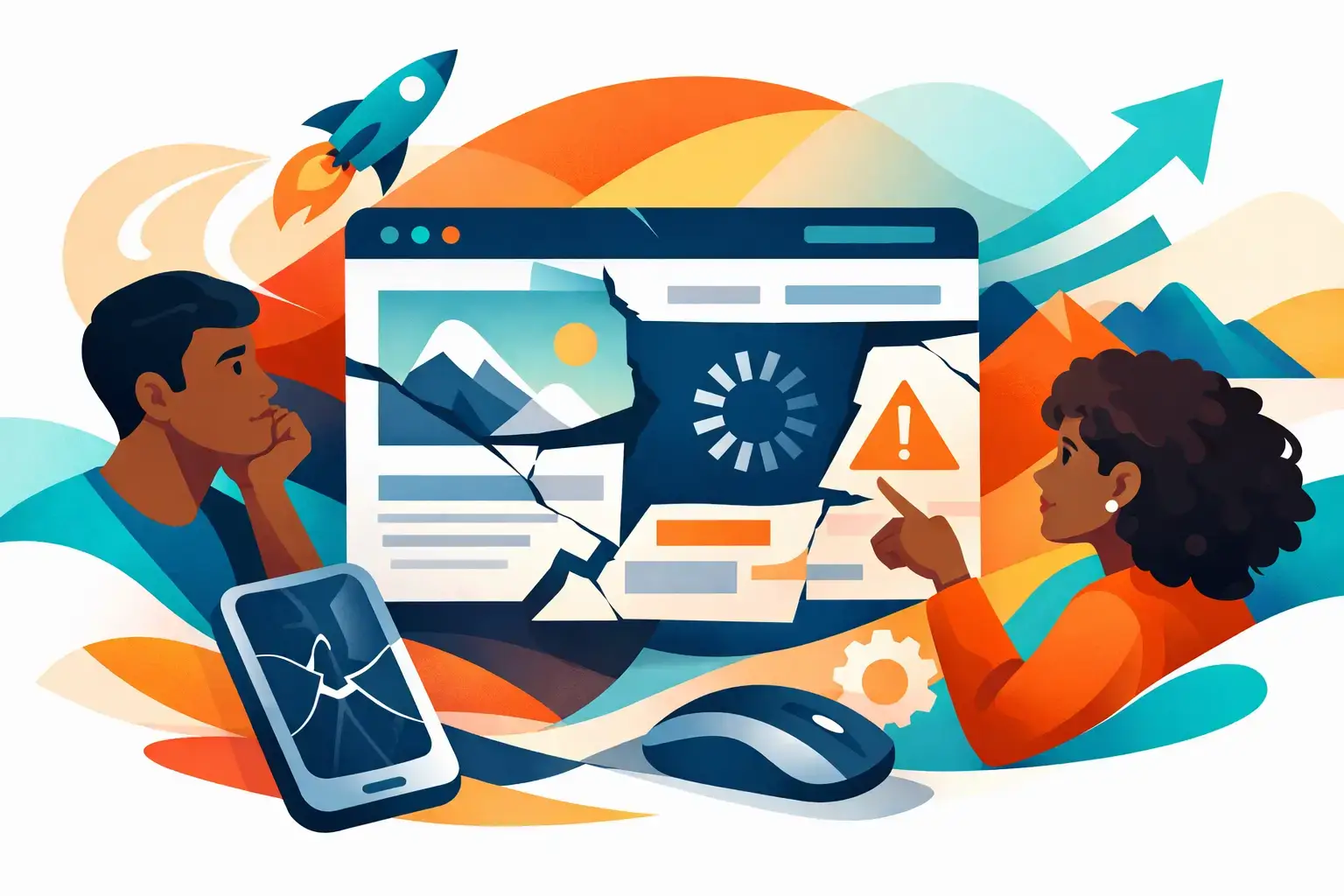
A referral finally lands on your website after hearing great things about your Fort Collins business. They are interested, ready to compare options, and one click away from forming an opinion. Then they meet a slow page, a vague headline, outdated team photos, and a contact form that feels like a commitment to buying a timeshare.
That gap matters. The signs your Fort Collins business needs a new website are rarely limited to appearances. A website can look passable while quietly weakening trust, hiding your expertise from search, and sending qualified prospects toward a competitor with a clearer story.
A new website is not always the answer. Sometimes a focused messaging, SEO, or conversion optimization effort can extend the life of a solid platform. But when the issues are structural, cosmetic updates become expensive camouflage.
Signs Your Fort Collins Business Needs a New Website
1. Your website does not explain what you do quickly enough
Visitors should not have to decode your business. If your homepage leads with broad phrases like “innovative solutions” or “exceptional service” but fails to name the real problem you solve, the right audience may leave before reaching your strongest proof.
This is especially common among professional service firms, technology consultancies, and established local businesses with a wide range of capabilities. The organization has evolved, but the website still describes the company it was three pivots, two leadership changes, and a dozen client wins ago.
Strong messaging does more than sound polished. It tells a prospective client who you help, what outcomes you create, why your approach is different, and what to do next. Clarity is not a creative compromise. It is a conversion tool.
2. Your brand and website feel like separate businesses
A growing company often invests in better positioning, sales materials, recruiting, and client experience before revisiting its website. Then the site becomes the weak link: old colors, inconsistent typography, generic imagery, or a tone that no longer matches the caliber of work.
For Fort Collins businesses competing across Colorado and beyond, perception travels fast. Prospects may find you through a referral in Old Town, a Google search from Denver, or a LinkedIn mention from a colleague in another state. In each case, your website has to support the reputation that got them there.
A visual refresh alone may help if the underlying structure and content are strong. But if the brand story, navigation, service architecture, and calls to action are also misaligned, you need more than new paint. You need a digital experience built around how people actually evaluate your business.
3. Mobile visitors have a worse experience than desktop visitors
Many decision-makers first check a company from their phone between meetings, while traveling, or after a recommendation lands in their inbox. If text is difficult to read, pages jump as they load, forms are frustrating, or key proof gets buried, the business is creating avoidable friction at the first moment of interest.
Mobile performance is not just a technical checklist. It changes how credible and easy to work with you appear. A clean, fast mobile experience signals operational maturity. A clumsy one makes even a great company feel harder to engage.
Look at your analytics before assuming. If mobile traffic is meaningful but mobile users spend less time on site, view fewer pages, or convert at a much lower rate than desktop users, the gap deserves investigation. The cause may be design, page speed, content hierarchy, or a form experience that asks too much too soon.
4. Your site attracts traffic but does not generate qualified conversations
Traffic is useful. Revenue is better.
If people reach your website but rarely request a consultation, demo, estimate, or strategic conversation, your site may be operating as a brochure rather than a business development asset. This is often a positioning problem disguised as a marketing problem.
Prospects need enough information to feel confident taking the next step. That includes credible examples of your work, relevant industry context, clear service pages, proof of results where appropriate, and calls to action that match their stage of consideration. Someone comparing architecture firms may want to review project expertise. A SaaS buyer may need to understand implementation, integrations, and security. A generic “Contact Us” button cannot carry the entire buying journey.
Conversion improvements do not always require a full redesign. But when the site lacks a logical path from discovery to decision, a new information architecture and user experience can change the equation.
5. Your services have changed, but your site has not
Growth-focused businesses add offerings, refine their ideal clients, enter new markets, and develop deeper expertise. Meanwhile, their websites often preserve an old menu of services because changing it feels complicated.
That creates two problems. First, prospects cannot see the full value of what you do. Second, search engines have limited context for the expertise you want to be known for. A thin service page with a few broad paragraphs is unlikely to compete with a company that clearly addresses specific needs, industries, questions, and outcomes.
This does not mean every service deserves its own bloated page. It depends on demand, buying complexity, and strategic importance. The point is to make your website reflect the business you are actively building, not merely the business you started.
6. Publishing a page feels risky, slow, or dependent on a workaround
A website should support momentum, not create a bottleneck every time your company launches a new service, enters an industry vertical, hires a leader, or wants to share a case study. When simple updates require awkward workarounds or cause visible layout problems, the underlying system is working against your team.
This becomes more costly over time. Marketing delays become missed campaign windows. Sales keeps sending outdated PDFs because the website is not ready. Leaders stop proposing improvements because everyone expects the process to be painful.
A well-planned website gives your team structure without handcuffs. It should make common content updates manageable while preserving design standards, SEO fundamentals, and performance. Custom functionality is worthwhile when it supports a real operational need, not because adding complexity sounds impressive in a project kickoff.
7. Your website is difficult to find for the work you want more of
Search visibility is not a mystery, but it is cumulative. If your website has unclear page topics, duplicated content, weak internal structure, slow performance, or no meaningful depth around key services and industries, it will struggle to establish relevance.
For a Fort Collins business, local visibility can matter, particularly when buyers search for a nearby partner. But location is only one layer. A cybersecurity firm, legal organization, or specialized consultancy may compete for searches that are driven by expertise rather than geography. The website needs to meet both realities without turning every page into a string of place names.
An SEO audit can reveal whether the foundation is repairable. In some cases, technical and content improvements are enough. In others, the existing site structure makes it harder to organize content around how customers search and how the business wants to grow. That is when rebuilding becomes the more strategic decision.
8. You are embarrassed to send prospects there
This is the bluntest signal, and usually the most honest one. If your sales team apologizes for the site, avoids sharing certain pages, or sends people directly to a PDF instead, your website is not carrying its share of the load.
Embarrassment often comes from more than aesthetics. It comes from knowing the site does not represent the intelligence of your people, the quality of your work, or the standard clients can expect. The business has outgrown it.
That is not vanity. Buyers use digital cues to reduce risk. Before they schedule a conversation, they are asking quiet questions: Do these people understand companies like mine? Are they credible? Will this process be organized? Is their work current? Your website should answer those questions before the first meeting.
Decide Whether to Redesign or Optimize First
Before committing to a new website, assess the problem honestly. A targeted optimization effort may be the right move when your platform is stable, the brand is current, the site architecture makes sense, and the primary issues are isolated to speed, a few key pages, or conversion paths.
A full redesign becomes more compelling when several issues stack up: outdated positioning, inconsistent branding, weak mobile usability, poor search performance, hard-to-manage content, and low-quality lead flow. At that point, patching the site can cost more attention than rebuilding it with a clear strategy.
The best website projects start with business questions, not a gallery of visual inspiration. What kind of work do you want more of? Which audiences are most valuable? What objections slow down sales? What proof changes minds? Those answers shape the strategy, content, UX, and technology decisions that follow.
Your website does not need to be flashy to perform. It needs to make your value easier to understand, your expertise easier to trust, and the next step easier to take. If it cannot do those things, it may be time to give your business a platform that can keep up.
Frequently asked questions (FAQs)
How do I know if my Fort Collins business website needs to be redesigned?
Key signs include unclear messaging about what you do, misalignment between your brand and website design, poor mobile experience, low conversion rates despite decent traffic, outdated service offerings, difficulty publishing new content, and poor search visibility. If your sales team hesitates to share your site with prospects, that’s often the clearest indicator that a redesign is needed.
Why is clear messaging important for a business website?
Clear messaging helps visitors immediately understand who you help, what problems you solve, and why your approach is different. Vague phrases like “innovative solutions” cause qualified prospects to leave before discovering your strongest value. Strong messaging is a conversion tool, not just a creative flourish—it directly impacts whether visitors take the next step.
How does mobile performance affect my website's credibility?
A clean, fast mobile experience signals that your business is operationally mature and easy to work with, while a clumsy mobile site makes even great companies seem harder to engage. Since many decision-makers first visit your site from their phone, poor mobile performance creates unnecessary friction at the critical moment of initial interest.
What's the difference between website traffic and qualified leads?
Traffic alone doesn’t guarantee business results—what matters is whether visitors convert into consultations, demos, or strategic conversations. If your site attracts visitors but few take action, it’s likely functioning as a brochure rather than a business development tool, often due to missing credible examples, unclear service pages, or calls to action mismatched to where prospects are in their buying journey.
How does an outdated website affect my search visibility?
Unclear page topics, thin content, weak internal structure, and slow performance make it difficult for search engines to establish your relevance for the work you want. If your website doesn’t have meaningful depth around key services and industries, you’ll struggle to compete for searches driven by expertise—especially important for Fort Collins businesses serving regional or national markets.
Should I rebuild my website or make targeted improvements?
A focused messaging, SEO, or conversion optimization effort can extend a solid platform’s life if the underlying structure is sound. However, when issues are structural—such as an outdated information architecture that doesn’t reflect your current services or makes content updates difficult—rebuilding becomes the more strategic investment than cosmetic updates.