

A brand project can go sideways fast when the first meeting stays at the surface. If you only talk about colors, competitors, and a logo wishlist, you miss the real drivers of performance. The best brand discovery questions get underneath the visuals and into the decisions that shape positioning, messaging, conversion, and long-term growth.
For founders, marketing leaders, and teams preparing for a rebrand or new website, discovery is where momentum either starts or stalls. Good questions reveal what the business is trying to become. Better questions expose the friction standing in the way.
Why brand discovery matters more than most teams expect
Brand discovery is not a formality before creative work starts. It is strategic groundwork. It tells you whether the problem is awareness, differentiation, trust, lead quality, internal alignment, or a mix of all five.
That distinction matters because a brand is not just an identity system. It influences how your website converts, how your sales team tells the story, how prospects compare you to competitors, and how confidently your business can scale. If discovery stays shallow, the output usually does too.
The strongest discovery process also prevents expensive rework. It helps teams avoid building a polished brand around the wrong message, the wrong audience, or the wrong business priority. That is why the questions themselves matter so much.
What the best brand discovery questions actually do
Not every question deserves a seat in the room. Some only collect background information. Others create clarity.
The best brand discovery questions do three things at once. They uncover business truth, force prioritization, and create usable direction for strategy and execution. If a question leads to vague answers that cannot inform messaging, design, content, or digital performance, it is probably not pulling its weight.
A strong discovery conversation should help you understand how the company makes money, why customers choose it, where the current brand is underperforming, and what success needs to look like six to twelve months from now. Anything less is just intake.
25 best brand discovery questions to ask
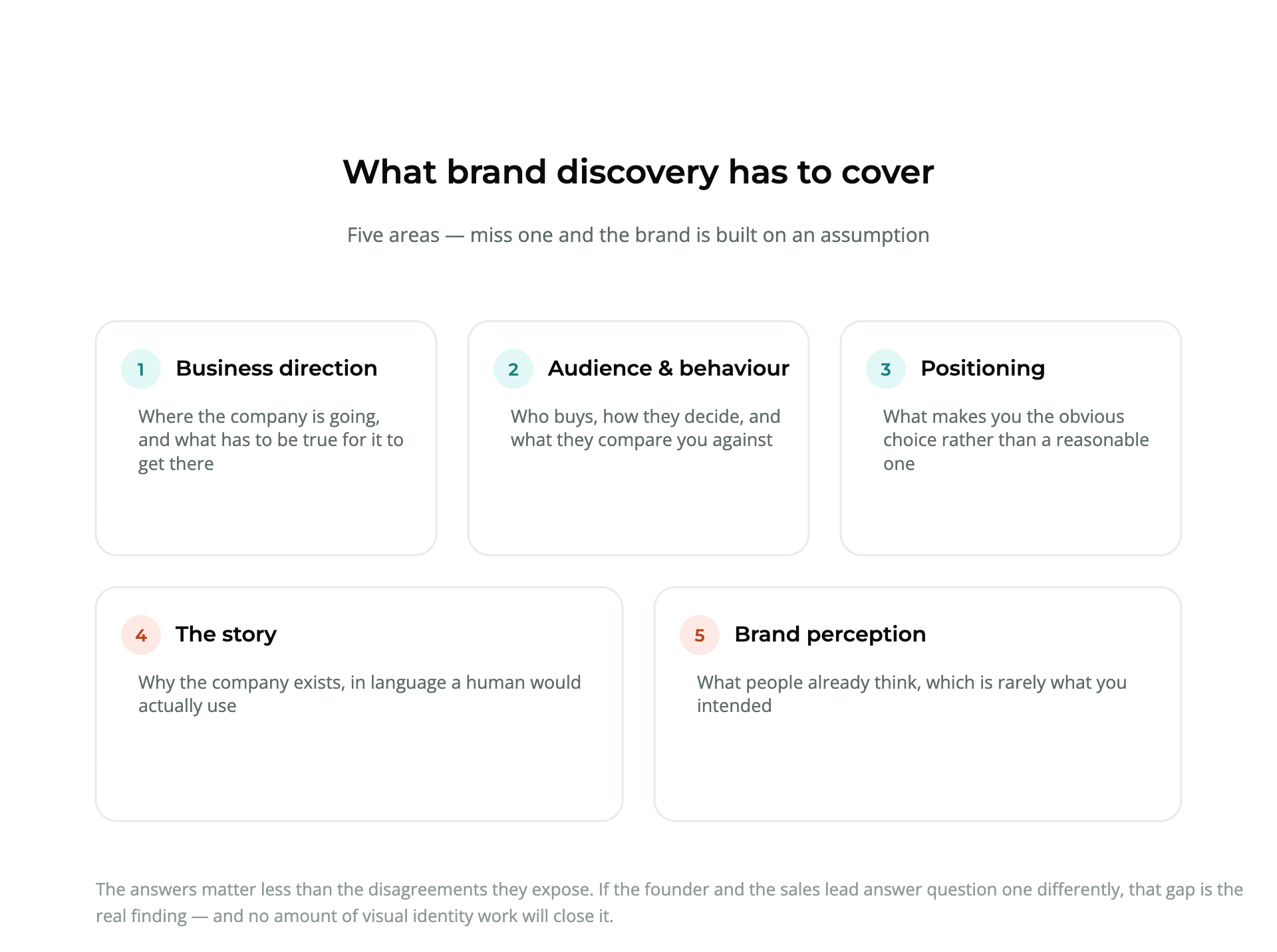
Questions about business direction
Start with the commercial reality. A brand should support the business model, not sit beside it.
- What is changing in the business right now, and why does the brand need to evolve with it?
- What are your growth goals over the next 12 to 24 months?
- Which products or services drive the most revenue, and which ones matter most strategically?
- What kind of customer do you want more of, not just more customers in general?
- If the brand worked harder for the business, what would improve first: awareness, trust, conversion, retention, or sales efficiency?
These questions move the conversation away from taste and toward outcomes. That shift is critical. A startup trying to establish market credibility needs a different brand system than an established company trying to improve lead quality.
Questions about audience and behavior
A surprising number of companies think they know their audience until they are asked to describe decision-making behavior instead of demographics.
- Who is the ideal buyer, and what usually triggers them to start looking for a solution like yours?
- What problem feels most urgent to that buyer before they contact you?
- What objections or hesitations slow down the sale?
- Who influences the decision besides the primary buyer?
- What does the customer need to believe before they are ready to trust your brand?
These answers shape more than messaging. They influence UX, content hierarchy, proof points, calls to action, and even the structure of a homepage. If your buyer needs confidence before commitment, your brand has to communicate evidence, not just energy.
Questions about positioning and differentiation
This is where discovery gets sharper. Many businesses claim they are different, but very few can explain their edge without sounding interchangeable.
- Why do customers choose you over alternatives?
- Why do some prospects choose a competitor instead?
- What do competitors consistently say, and where do they all sound the same?
- What can your company credibly claim that others cannot?
- If you disappeared tomorrow, what would customers miss most?
These questions force a team to confront the difference between internal assumptions and market reality. Sometimes the real differentiator is not the product itself. It might be speed, clarity, service model, technical depth, or the ability to solve a broader business problem in one engagement.
The best brand discovery questions for messaging
Messaging failures are usually clarity failures. When a brand struggles to explain what it does, who it serves, or why it matters, design alone cannot fix it.
Questions that sharpen the story
- How do you explain what you do in one sentence today, and where does that explanation fall short?
- What do clients misunderstand about your business most often?
- Which claims are essential to communicate on day one?
- What proof supports those claims?
- What tone should the brand project, and what tone would feel off-brand or damaging?
This part of discovery helps separate aspirational language from believable language. A company may want to sound innovative, premium, or disruptive, but if those words are not backed by experience, process, or outcomes, they ring hollow. Strong messaging is always tied to evidence.
Questions about brand perception
- How is the brand perceived today by clients, prospects, and internal teams?
- How do you want the brand to be perceived a year from now?
- What parts of the current brand are still valuable, and what needs to go?
- Where is the disconnect between who you are and how you currently show up?
- If this brand update succeeds, what will people say about your business that they are not saying today?
These questions are powerful because they expose the gap between identity and reputation. That gap is often where the best strategy lives.
How to use brand discovery answers without getting lost in them
The trap in discovery is collecting too much information and treating every answer as equally important. It is not. Some answers point to the core strategy. Others are just context.
After discovery, look for patterns in four areas: business goals, audience pain points, competitive whitespace, and trust signals. If the same themes keep showing up, that is where your brand needs to focus.
It also helps to watch for contradictions. A team might say they want premium positioning but insist on messaging that appeals to everyone. They might say they want better leads while keeping a website structure designed for volume over qualification. Discovery should not smooth over these conflicts. It should bring them into the open.
This is where an experienced partner adds real value. The right process does more than document answers. It interprets them, pressure-tests them, and translates them into brand architecture, visual direction, messaging strategy, and digital decisions that improve performance.
Website discovery questions to ask before a redesign
Brand discovery and website discovery overlap, but they are not the same conversation. Brand discovery asks who you are. Website discovery asks what the site has to do about it. If you are briefing a redesign rather than a rebrand, these are the questions worth asking first.
- What specific action do you need a visitor to take, and how often does that happen today?
- Which pages currently generate enquiries, and which ones do people leave from?
- Who signs off the purchase, and what do they need to see that the end user does not?
- How long is the buying cycle, and how many times will someone visit before they contact you?
- What do prospects ask on every sales call that the website should already have answered?
- Which competitors do people compare you against, and what do those sites do better?
- What content already exists, and what has to be written before launch rather than after?
- Who will maintain the site once it is live, and what is their level of comfort doing that?
- What has to stay — rankings, URLs, integrations — and what can safely be retired?
- How will you know in six months whether the redesign worked?
The last one catches people out. A redesign without a measurable definition of success tends to get judged on whether the client likes the look of it, which is the one criterion that has no relationship to whether it earns money.
Common mistakes when asking brand discovery questions
One mistake is asking questions that are too broad. “Who are you as a brand?” sounds strategic, but it often produces abstract answers that no one can execute. A more useful question is, “What does a prospect need to understand about you within the first 10 seconds of visiting your website?”
Another mistake is talking only to leadership. Executives provide direction, but sales teams, customer-facing staff, and even long-term clients often reveal where the real friction lives. If your goal is stronger conversion and clearer positioning, you need both strategic and frontline perspective.
The third mistake is treating discovery as a branding exercise only. For growth-focused businesses, brand decisions affect website structure, SEO priorities, content strategy, lead qualification, and conversion paths. That is why discovery should connect creative thinking with commercial outcomes.
When to revisit your brand discovery process
Discovery is not only for new brands or full rebrands. It also makes sense when lead quality drops, the sales cycle gets longer, your business expands into new markets, your offer changes, or your website no longer reflects how you actually win work.
For companies in competitive markets like Fort Collins, Denver, Boulder, or larger national and UK-facing spaces, small positioning gaps can have an outsized impact. When buyers have options, clarity becomes a growth tool.
A modern agency approach should treat discovery as the bridge between strategy and execution. That means the answers should shape not only a brand platform, but also the website experience, content decisions, and digital performance systems that follow. That is where the work starts producing measurable value, not just better-looking assets.
The smartest brand questions do not just help you describe your business better. They help you build one that is easier to choose.