

If your pipeline needs leads this quarter, paid ads look like the obvious answer. If you want compounding visibility that keeps working after the campaign ends, SEO starts to look a lot smarter. That tension is exactly why the seo strategy vs paid ads conversation matters so much for growth-focused businesses.
Too many companies treat this like a winner-take-all decision. It usually is not. The real question is where your business needs speed, where it needs staying power, and how your website, messaging, and conversion path support either channel. Traffic by itself does not move a business forward. Qualified traffic that converts does.
SEO strategy vs paid ads: the real difference
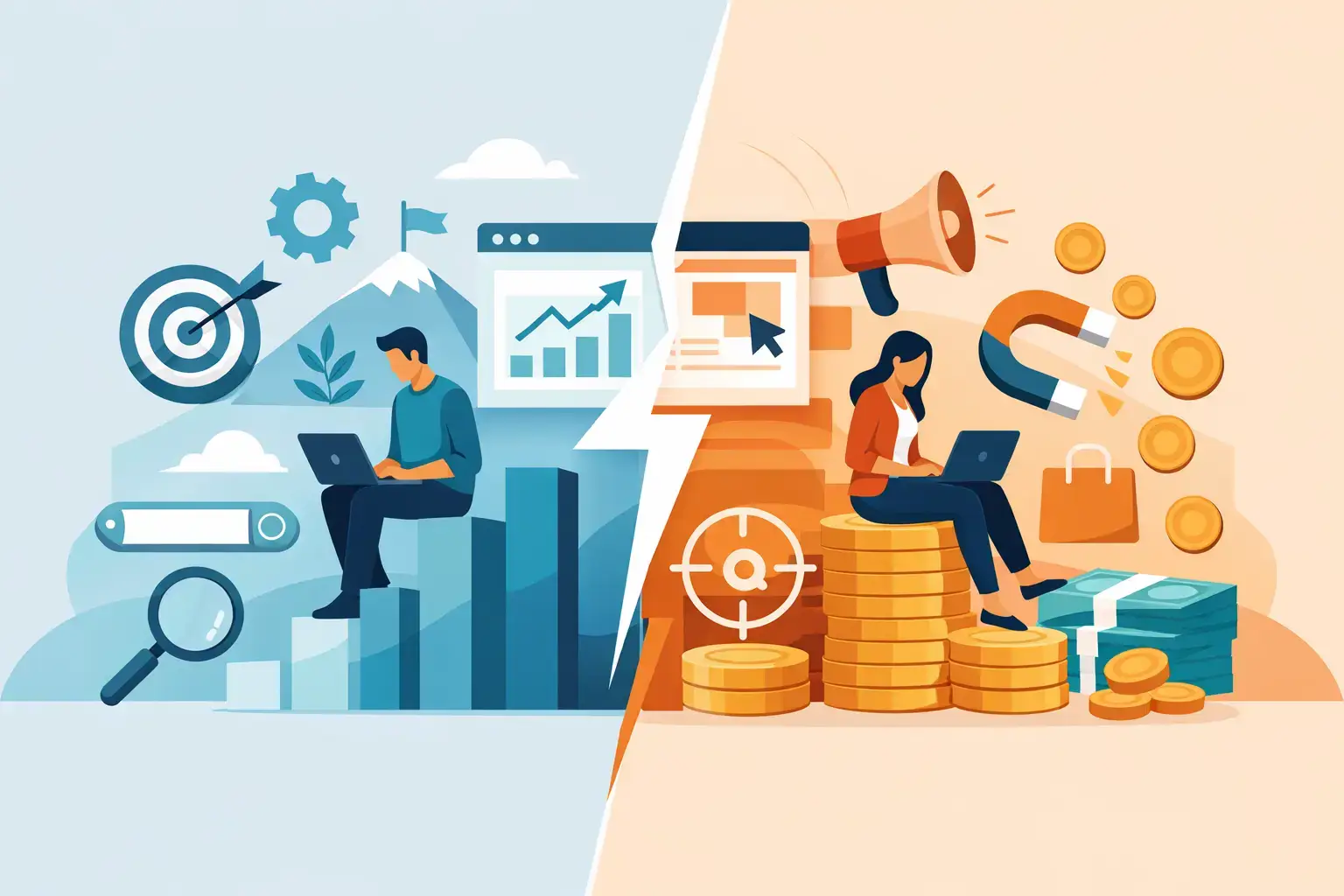
At a high level, paid ads buy attention. SEO earns attention. One gives you immediate placement in front of a defined audience. The other builds visibility over time by aligning your site, content, technical setup, and authority with what people are already searching for.
That difference shapes everything from cost structure to lead quality. Paid ads can generate traffic this week, but the moment you stop funding them, the flow slows down or stops. SEO takes longer to gain momentum, but strong rankings can keep producing qualified visits long after the initial investment.
This is why comparing them only on short-term lead volume misses the point. They solve different business problems. Paid ads are useful when you need fast testing, targeted reach, or immediate demand capture. SEO is valuable when you want to lower dependency on paid acquisition and build a stronger digital asset over time.
When paid ads make more sense
Paid ads are often the right move when timing matters. If you are launching a new service, entering a competitive market, promoting a time-sensitive offer, or trying to validate messaging quickly, ads give you a faster feedback loop than SEO ever will.
They also work well when your audience is highly specific. You can target by intent, geography, demographics, and behavior with a level of precision organic search cannot always match. For a business trying to break into a crowded category, that control can be incredibly valuable.
But there is a catch. Paid traffic magnifies whatever is already happening on your website. If your landing page is unclear, your offer is weak, or your conversion experience is clunky, spending more does not solve the problem. It just makes the problem more expensive.
That is where many campaigns underperform. The ad itself is not the issue. The positioning is off, the site does not build trust, or the call to action asks for too much too soon. Paid ads can absolutely drive growth, but they need sharp creative, strong targeting, and a conversion-focused destination to work at full strength.
When SEO makes more sense
SEO tends to make more sense when your buyers actively research before they buy. If prospects compare vendors, look for answers, evaluate service options, or search repeatedly across the buying cycle, organic search can become one of your most efficient channels.
It is especially powerful for businesses with specialized expertise and clear market differentiation. When your website reflects what you do well, who you serve, and why your approach is different, SEO helps that value show up at the exact moment buyers are looking.
Good SEO is not just publishing articles and hoping for rankings. It is technical performance, site structure, search intent alignment, on-page clarity, local relevance when appropriate, and content that supports real decision-making. Done well, it improves discoverability and strengthens the user experience at the same time.
That last point matters. SEO often creates value beyond traffic. It forces better information architecture, clearer messaging, faster load times, and stronger page relevance. Those improvements can raise conversion performance across every traffic source, not just organic search.
SEO strategy vs paid ads on ROI
This is where business owners and marketing leaders want a straight answer, and the honest answer is it depends on your timeline, sales cycle, and current digital maturity.
Paid ads can show ROI faster because results appear quickly. You launch, monitor, optimize, and see what happens in days or weeks. That speed is useful, particularly if you need lead flow now or want to test an offer before investing heavily in content and SEO infrastructure.
SEO usually produces slower early returns and stronger long-term economics. The upfront work can be substantial. You may need a technical audit, revised site architecture, content improvements, stronger landing pages, and a more strategic keyword map. But once performance builds, the cost per acquisition often becomes more attractive than paid media alone.
The mistake is expecting SEO to behave like paid ads or judging paid ads like a long-term brand asset. These channels are measured differently because they create value differently. Paid media is an active expense. SEO is closer to building an owned growth engine.
The hidden variable: your website
Most discussions around seo strategy vs paid ads leave out the factor that usually decides performance: the website itself.
If your site is slow, confusing, visually dated, or weak on trust signals, both channels suffer. SEO struggles because search engines prioritize useful, relevant experiences. Paid campaigns struggle because users click and then bounce without taking action. In both cases, acquisition gets blamed when the real problem is conversion.
This is why high-performing growth strategies are rarely channel-only strategies. They connect visibility with UX, messaging, technical execution, and conversion design. A business does not just need more traffic. It needs a site that turns interest into action.
For example, a company investing in ads for a high-value service may see click volume but poor lead quality because the landing page speaks too broadly. An SEO-driven business might rank for the right terms but fail to convert because the page does not clearly explain its process, proof, or differentiation. Different channels, same core issue.
The smartest move is often both
In many cases, the strongest strategy is not choosing one over the other. It is using each channel for what it does best.
Paid ads can generate immediate visibility, support new offers, and reveal which headlines, audiences, and calls to action resonate fastest. SEO can turn those insights into a long-term organic strategy that compounds over time. One drives speed. The other builds stability.
This combination is particularly effective for businesses in growth mode. Ads can fill the top of the funnel while SEO reduces future acquisition pressure. Meanwhile, website improvements made for one channel often improve results for the other.
There is also a strategic advantage in reducing channel dependency. If all lead generation comes from paid ads, every performance dip hits harder. If all growth depends on SEO, algorithm shifts or slower content execution can create risk. A balanced mix gives you more control.
How to decide where to invest first
If you need leads quickly, start with paid ads – but only if your offer is clear and your landing experience is ready. If your website already has authority, your buyers search actively, and you are thinking beyond the next quarter, SEO may be the smarter first investment.
If you are unsure, look at three things. First, how urgent is revenue growth? Second, how strong is your website conversion path today? Third, are people already searching for what you sell in meaningful volume?
A business with urgent sales goals and a solid site may benefit from paid campaigns immediately. A business with a longer runway and a content-rich buying journey may gain more from an SEO-led approach. A business with weak positioning and an underperforming website should probably fix the foundation before pushing hard on either channel.
That is where an integrated partner can make a real difference. Agencies like Tripsix Design approach growth more holistically by connecting brand clarity, website performance, SEO, and paid strategy instead of treating them as disconnected tasks. That usually leads to better decisions and better economics.
What winning actually looks like
Winning is not ranking for vanity terms. It is not generating lots of clicks that never turn into conversations. It is building a search and acquisition system that attracts the right audience, communicates value quickly, and turns interest into measurable business momentum.
Sometimes that starts with paid ads because speed matters. Sometimes it starts with SEO because long-term visibility matters more. Often it starts with getting brutally honest about whether your website and messaging are ready to support growth at all.
The best strategy is the one that fits your market, your goals, and your current stage of maturity. If you make the decision based only on channel hype, you will likely overspend. If you make it based on business reality, you give yourself a much better chance of building traction that lasts.
A strong brand, a high-converting website, and the right acquisition mix will outperform a bigger ad budget or a pile of disconnected SEO tasks every time.
Frequently asked questions (FAQs)
What's the main difference between SEO and paid ads?
Paid ads buy immediate attention and traffic, with results appearing within days or weeks, but stop generating traffic once you stop funding them. SEO earns attention over time by aligning your website with what people search for, takes longer to gain momentum, but can produce qualified traffic long after the initial investment ends.
When should I use paid ads instead of SEO?
Paid ads make sense when you need fast results, are launching a new service, entering a competitive market, promoting time-sensitive offers, or want to test messaging quickly. They’re also ideal when your audience is highly specific and you need precise targeting by intent, geography, demographics, or behavior.
When is SEO the better choice for my business?
SEO works best when your buyers actively research before purchasing, compare vendors, and search repeatedly throughout their buying cycle. It’s especially powerful for businesses with specialized expertise and clear differentiation, and it often improves conversion rates across all traffic sources, not just organic search.
Which channel has better ROI—SEO or paid ads?
Paid ads show ROI faster with results in days or weeks, making them useful for immediate lead generation. SEO typically produces slower early returns but stronger long-term economics and lower cost per acquisition once performance builds, making it better suited for sustained growth.
Why does my website matter more than choosing between SEO and paid ads?
Your website is the conversion engine for both channels—if it’s slow, confusing, or lacks trust signals, both SEO and paid ads will underperform. Poor landing pages, unclear messaging, and weak conversion paths cause both organic and paid traffic to bounce without converting, making website quality the hidden variable that decides overall performance.
Should I use both SEO and paid ads or just pick one?
The strongest strategy for most growth-focused businesses uses both channels together: paid ads drive immediate visibility and reveal what messaging works, while SEO builds long-term organic growth and reduces future acquisition costs. This balanced approach also reduces risk by preventing over-dependence on a single traffic source.